
Letter to Lake Users from the CLCS Lake Management Committee
The lake is a living, thriving organism. The CLCS Lake Management Committee arranges treatments and activities that aim to maintain lake quality, but the climate and environment dictate the actual condition of the lake. We would like to give some insight into what you are seeing around the lake this season.
Lake Level
The level of the lake is 6 to 8 inches below normal. The dam was closed as scheduled in March, but with rainfall well below normal, the lake has not refilled and probably will remain below normal all summer. In hot weather without rain, evaporation losses can lower the lake about an inch a week.
Weeds etc.
Early season control of invasive Curly Leaf pondweed was accomplished by a May 13th application of Tribune®.
Sonar® was applied June 10th to limit growth of invasive Eurasion Water Milfoil.
To knock back the unexpected explosive growth of the native weeds Big-leaf and Stringy Pondweed, the lake perimeter was treated June 29th with the herbicide Aquathol K.
More treatments may be considered. The lake can experience late season growth of native Water Stargrass which can affect navigation in shallow areas.
All treatments include copper sulfate to maintain algae control.
“Green Slime” Algae and Water Clarity
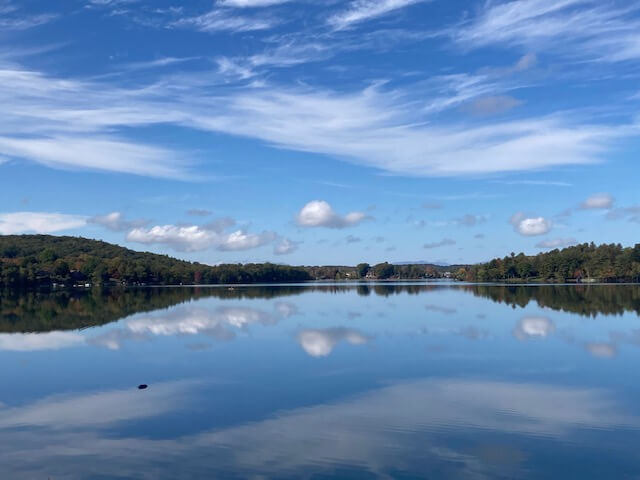
The clarity of Copake Lake is exceptional. This clarity results in more light reaching the lake bottom which promotes the growth of filamentous algae. The algae produces oxygen bubbles which lift the algae from the bottom to form floating islands of green slime. CLCS attempts to control the algae with treatments of copper sulfate. The lake's clear, warm water and abundant sunshine grow the algae faster than the two week limit between treatments. Filamentous algae is harmless; it just looks bad.
Swimmer’s Itch
A parasite causing swimmer's itch occurs naturally in the lake. Black snails incubate the parasite which sends out larvae seeking waterfowl to grow to the next stage. The parasite larvae mistake humans for ducks and cause skin irritation. Total elimination of either black snails or ducks would be required to end swimmer's itch. CLCS is not capable of or permitted to do either. Copper sulfate, which is used to control algae, has not had much effect on swimmer's itch. See our swimmer’s itch information page or the latest CLCS newsletter for prevention and treatment options.
Zebra Mussels
Zebra mussels are widespread across New York State. They are invasive, devastate local ecosystems by outcompeting native species, and can foul boats, motors, docks and the lake bottom.
They were first noticed in our lake in 2021, and $80,000 worth of treatments in 2022 attempted to control them. After 3 years of only minor activity, the growth accelerated last year, so a 2-step treatment with EarthTec® is planned for mid-July, with the first treatment occurring July 7 and the second treatment about 2 weeks afterwards. There will be no restrictions on lake activity as this is a copper based treatment in parts per billion concentration.
This treatment cost is estimated at $80,000. CLCS will be conducting a special raffle this season to help offset the cost of the treatment.
The combination of drought, warm weather and exceptional clarity of the lake water has magnified all the above concerns. The CLCS Lake Management Committee is working to maintain lake quality for you in the face of changing conditions.
Use the lake in good health.