
Frequently Asked Questions (FAQs)
Welcome to our FAQs page. Click on any of the questions below for answers to commonly asked questions.
We welcome your input on additional information that you believe would be useful to add to our FAQs. Please email your suggestions to info@copakelakecs.org.
BOATING and SWIMMING ON COPAKE LAKE
Yes, watercraft must not exceed 5 mph between 8 PM and 9 AM (Copake Town Ordinance). In addition, all watercraft must slow down to 5 mph when less than 100 feet from shore, dock or other vessel, or in ‘no wake’ zones (NYS Law).
For a more complete description on NYS Boating Safety Regulations, Click on this link.
A No Wake Zone is a designated area within a body of water in which the speed limit for any vessel cannot exceed 5 MPH. This includes anytime you are less than 100 feet from the shore, from a dock, or from any other vessel.
New boating regulations adopted by New York State on May 1, 2014 require all individuals born on or after May 1, 1996 to successfully complete an approved Boating Safety Course in order to operate a motor boat. In addition, motor boat operators who are younger than 18 years of age must be accompanied by a person who is at least 18 years of age or older, and who is either the holder of a boating safety certificate, or not required by law to hold a certificate.
A personal watercraft (PWC), also called a water scooter, is a recreational watercraft that the rider sits or stands on, rather than inside of, as in a boat. PWCs have an inboard engine driving a pump jet that has a screw-shaped impeller to create thrust for propulsion and steering. They are often referred by the trademarked brand names Jet Ski, Wave Runner, or Sea-Doo.
Yes, it is true. The minimum age for anyone who operates a personal watercraft is 14 years old, and people operating a personal watercraft must complete an approved course in boating safety. If someone younger than 14 operates a PWC, he or she must be accompanied, on board, by someone 18 years of age or older who is the holder of an approved boating safety certificate. Certificates are required to be carried at all times when operating the personal watercraft. For more details regarding this requirement, Visit
Every pleasure vessel including motor boats, canoes, kayaks, personal watercraft, paddle boards and rowboats operated upon the waters of NYS must have on board one U.S. Coast Guard approved wearable PFD for each person on the vessel. In addition:
For more information on laws regarding PFD’s, Click on this link.
Any youth under the age of 12 on boats 65 feet or less in length must wear a securely fastened U.S. Coast Guard approved PFD of appropriate size at all times. It does not apply if the youth is in a fully enclosed cabin.
Stand up paddlers are becoming a more and more common sight on Copake Lake. Paddleboards are considered to be “vessels” by the U.S. Coast Guard, which means that the following rules apply.
Lake water temperature is always recorded in the shade, in about 2 feet of water at the Golf Course Road bridge. In that location on sunny days in June, July and much of August, the lake varies in temperature by about 5 degrees F every day. It is at its lowest at about 9 am and at its highest at about 5 pm. On cloudy days there is less change and on rainy days there may be no change or the temperature may even drop a little. As September approaches, there is less daily temperature variation and the overall trend is downward.
In more open water, there will be more temperature variation due to more exposure to the sun, so much so that many people think that they are swimming through colder springs near the bottom of the lake. This is not the case, however. Swimmers are simply encountering cooler water below the sun-warmed surface.
The CLCS is not an enforcement agency. Concerns about speed, noise or safe handling of any motorized watercraft on the lake should be directed to the Columbia County Sheriff’s Department at 518-828-3344. It is helpful if you can give a license plate number and/or a description of the watercraft.
winter sports on copake lake
Yes, winter sports including snowmobiling, skating, fishing, and cross-country skiing are permitted on Copake Lake. Please be aware that there is no official monitoring of ice thickness, therefore participation in winter activities on the lake is at your own risk. For more information visit our Winter Safety page.
To view the NYS Department of Parks and Recreation Snowmobilers Guide.
There is a common saying: Thick and blue, tried and true. White and crispy, way too risky. Please be aware that there is no official monitoring of ice thickness, therefore participation in winter activities on the lake is at your own risk. If you are not sure, stay off the ice!
This infographic, courtesy of Adirondack.net, demonstrates the minimum ice thickness required for various activities.

lake management
Lake water temperature is always recorded in the shade, in about 2 feet of water at the Golf Course Road bridge. In that location on sunny days in June, July and much of August, the lake varies in temperature by about 5 degrees F every day. It is at its lowest at about 9 am and at its highest at about 5 pm. On cloudy days there is less change and on rainy days there may be no change or the temperature may even drop a little. As September approaches, there is less daily temperature variation and the overall trend is downward.
In more open water, there will be more temperature variation due to more exposure to the sun, so much so that many people think that they are swimming through colder springs near the bottom of the lake. This is not the case, however. Swimmers are simply encountering cooler water below the sun-warmed surface.
In order to protect the structures close to the shoreline from ice erosion and damage, we must draw down the lake level every winter. Because there is no way to refill the lake other than through rain and snowfall, we are totally dependent upon the amount of precipitation in any given year to maintain the lake level.
In the fall and winter, the lake drain valve is opened in order to lower the lake level, thus minimizing shoreline erosion due to ice movement during the spring thaw. Depending on weather conditions, the drain valve is closed in the late winter or early spring to refill the lake. If the lake and/or the ground are not frozen, and/or there is no snow on the ground, typically the drain valve is closed in January. If there's a foot or so of snow on the ground and the lake is frozen, closing the valve can wait until mid- to late-February, or even later. It has been closed as early as January and as late as April. In both of those extreme cases, the lake has been full again before the start of summer. The Lake Management Committee, based on prior experience and careful monitoring of weather conditions, makes decisions regarding when to open and close the valve.
For a more detailed explanation of Lake Level Management, click on the link.
There are actually two valves on the dam, a new one and an old one. The new one was added in the early 2000s and is inside the 18½-inch diameter pipe that passes through the dam. The old one, which came with the original dam, is at the entrance to the pipe. The two valves are in series so that either one is all that is needed to control or stop the flow of water through the dam. That is the only thing that they actually do. Closing them creates an opportunity for precipitation or runoff to raise the lake, but does not necessarily raise the lake. They are often called “drain valves” as opening them partly drains the lake.
During the cold weather, the new valve is locked open so that it will not freeze, which would severely damage it. It's not something we can repair, which means that it would have to be removed from its concrete encasement and sent back to its manufacturer for any repairs.
Little Known Fact: It takes 190 turns of its operating wheel to fully open or close the new valve. That's great exercise, but tedious, time consuming and if you don't keep count, you just don't know how open or closed the valve might be.
On the other hand, the old valve is not damaged by freezing, can be repaired locally by any carpenter, is easy to operate and how much it is open/closed is easy to determine visually. Unfortunately, it leaks a bit. Therefore we use the old valve mostly to control the rate of out-flow when down drawing the lake, and use the new valve to totally shut off out-flow in the warmer weather (keeping the lake level as high as possible).
From this point on, the two serial valves will be referred to simply as “the valve”.
The valve is used to change the lake level from its normal maximum value (i.e. full for the summer with water flowing out through the spillway), to its normal minimum value, (i.e. down drawn for the winter with water only flowing through the regulated valve). Both normal levels are only semi-stable, as fluctuating weather conditions can cause large changes to the amount of water going into and/or out of the lake at any given time. In the summer, the most significant change is caused by normal evaporation (about 1-inch of lake level is lost to evaporation each week in the summer), and that water loss which is exacerbated during times of drought. In the winter, the large changes are driven by rain falling on our frozen watershed, with little loss due to evaporation, causing the lake to rapidly rise. In simple terms, the lake has two normal semi-stable levels. Summer approximately full and winter, down drawn; depending on whether or not the valve is open or closed.
We usually open the valve just after Columbus Day to start to down draw the lake. With the valve fully open, it usually takes about a month or so for the lake to go down to its normal minimum level.
Everyone needs to fully understand that closing the valve at the end of the winter does not raise the lake level. Nearly all of the time, the lake level is going down due to evaporation notwithstanding how much the valve may be open or closed. Only rain and/or a melting/thawing watershed can raise the lake level.

Is Copake Lake spring-fed? It depends on who you ask.
To the average person, a spring-fed lake is one without obvious rivers or streams feeding it. Copake Lake fits this description, as it has a small watershed with few streams.
However, scientists and engineers define a spring-fed lake as one where most water comes from the ground. Data shows Copake Lake actually loses more water to the ground than it gains. Its level constantly drops unless replenished by rain or snowmelt, making it a precipitation-fed lake in scientific terms.
The warm "springs" felt while swimming are not groundwater springs, but convection currents caused by solar heating. Copake Lake does have a few cold groundwater springs, but they're insignificant compared to its water loss.
So, while Copake Lake may appear spring-fed to the casual observer, it doesn't fit the scientific definition. The lake's primary water source is precipitation, and its level is constantly fluctuating due to evaporation and groundwater loss.
As a reference point, the lake is deemed full any time there is water flowing out of the lake through the spillway. In the early 1900s, the lake was able to remain full most days of nearly every summer. It now is not always full every day of every summer. The main reason for all this is that the watershed, our primary source of water, has gone from nearly all fields to nearly all forest. Anywhere from 40% to 60% of rain falling on fields runs off into the lake. Only about 20% runs off our now forested watershed. We simply don’t get as much water as we used to. This change has happened during the lifetime of many of our current residents. There is realistically no way to change this. We simply have to adapt to the current conditions.

The herbicide known as Reward® has proven in recent years to be the most effective in controlling unwanted weeds which foul propellers and grow more problematic as the summer season wears on. New York State requires that we post a 14-day swimming ban on areas treated with this herbicide.
Important Information to Consider in relation to the 14-Day Swimming Ban:
The New York State Department of Environmental Conservation (DEC) requires that we send a riparian notice (notification to residents and visitors of actions affecting our watershed) for planned weed and algae treatments of Copake Lake, and further requires that we post 14-day restrictions on lake use after treatment with the herbicide Reward®. However, the United States Environment Protection Agency (EPA) and most other states (with the exception of New York) recommend a more limited restriction relating to the use of Reward®: "1- to 3-day restriction on drinking and irrigation; no swimming or fishing restrictions.” We hope that this information will help our members to make an informed decision about using the lake following a treatment.
The herbicide we typically use is a contact weed killer. This means that we cannot treat early in the spring because there is not enough weed growth for the herbicide to make contact with the weeds and have a meaningful effect in killing the aquatic plant growth. We have also found in our years of experience that when the treatment is applied too early in May there is significant weed growth by the end of August. By treating several weeks later, we are trying to maintain weed control later in the season and be more effective on controlling the weeds throughout the boating season.
The filamentous algae in your area is a naturally occurring result of clear water and abundant sunlight. The algae grows on the bottom and as it produces oxygen can rise to the surface and form mats. It is a green algae and is not hazardous to health. Our recommendation to shoreline owners is to take action on their own and rake or skim the algae from their areas and dispose of on land. It is harmless, it just looks icky.
A blue-green algae (Gloeotrichia) bloom is different from the common, green filamentous algae that we typically see in the lake late in the summer, and which we treat by applying a localized treatment with copper sulfate. In contrast, EXPOSURE TO BLUE-GREEN ALGAE BLOOMS CAN BE HARMFUL TO PEOPLE AND ANIMALS.
For more information about health concerns go to www.health.ny.gov and search "blue-green algae"
The CLCS posts notices around the lake when Gloeotrichia blooms are present, and again when the coast is clear.
Actually, the lake is usually 18 inches or less down all winter. What you are seeing is a natural artifact of the valve being open to downdraw the lake. When water is flowing (out the valve), its’ level has to go down in the direction of the flow. Conversely, if the level of a body of water has a sloped surface, then it is flowing in the direction of the slope. Think of a stream or river. While there is a lot of science involved here, that’s just how nature works. This phenomena has been recognized and understood since people have tried to direct water in a desired direction. Think irrigation.
The following video shows what you would see when the valve is open, the lake level is about 15 inches down and what happens when the valve is closed, as it would be for the summer. It’s more dramatic when the lake is 18 inches down. In that case, the water level at the dam can be completely below the bottom of the sight gauge. This phenomena does not have linear relationship.
While the valve is open, the only part of the lake that is lower than the actual lake level, extends from the face of the dam to to the old outlet, about 50 feet out into the lake past the Golf Course Road Bridge. The rest of the lake remains at whatever its’ current actual level is.
In fact, if the lake tries to get any lower than about 24 to 26 inches down, the lake water can’t even reach the valve. The flow is blocked by the old outlet, dating back to the early 1700s. The old outlet is now a shallow spot in the lake bottom and effectively limits our ability to downdraw the lake any farther.
COPAKE LAKE WILDLIFE
The Wildlife Health Unit (WHU) at New York State’s Department of Environmental Conservation (DEC) is the place to report dead wildlife. They are particularly interested in knowing about:
Of course, individual animals die of natural causes or due to accidents. Should you need to dispose of an animal carcass, keep in mind that it is important to protect both surface and groundwater from contamination. In addition, dead wildlife can be a health threat to people and other animals. We recommend that you read the guidelines on the WHU website carefully before handling or disposing of any dead wildlife. If you have any questions or concerns, call the NYS Department of Environmental Conservation, Region Four at (518) 357-2234.
Tens to hundreds of spawning fish dying in the spring is to be expected, especially if what you see is mostly pan fish and an assortment of other species like Bass, Perch, probably even a Bullhead, etc. According to our limnologist George Knoecklein, “We have occasionally seen post spawning mortality—as it is called—affect many more than this. Factor in the winter the fish just came through, making them stressed by living in less than optimum conditions for a long time. They are probably deficient in a number of life functions, such as nutrients, dissolved oxygen, and pH changes; all making the fish more prone to having no energy reserves to make it through spawning, which is an extremely taxing effort.”
If you see anything in or around the lake that you think is unusual, please photograph it and send it to us, indicating where and when it was seen. Our email is: info@copakelakecs.org
LAKE PROPERTY AND WATERSHED MANAGEMENT
Shoreline Clean Up:
Lawn Maintenance:
Below is a partial list of activities for which New York State Department of Environmental Conservation (DEC) permit is required:
Please contact the NYS Department of Environmental Conservation, Region 4 at (518) 357-2234, before undertaking any alterations to your shoreline.
If you can safely use a boat hook or other implement to remove trash or debris from the lake, please do so in order to protect other boaters and swimmers. If you cannot safely remove the debris yourself, please inform us at info@copakelakecs.org so that we can alert other members of the lake community of any potential danger.
COMMUNICATIONS
Email us any time with questions or comments: info@copakelakecs.org. You will receive a prompt reply.
Can I submit an article or photos for the website or print newsletter?
Yes, we welcome articles and photos for inclusion in our newsletter or on our website. Please email to us at info@copakelakecs.org
There are so many great articles in the CLCS newsletters. Is there anywhere that I can obtain copies of previous editions?
Yes, you can. There are PDF copies of all our newsletters since Spring 2011 archived on our website. You can view or download.
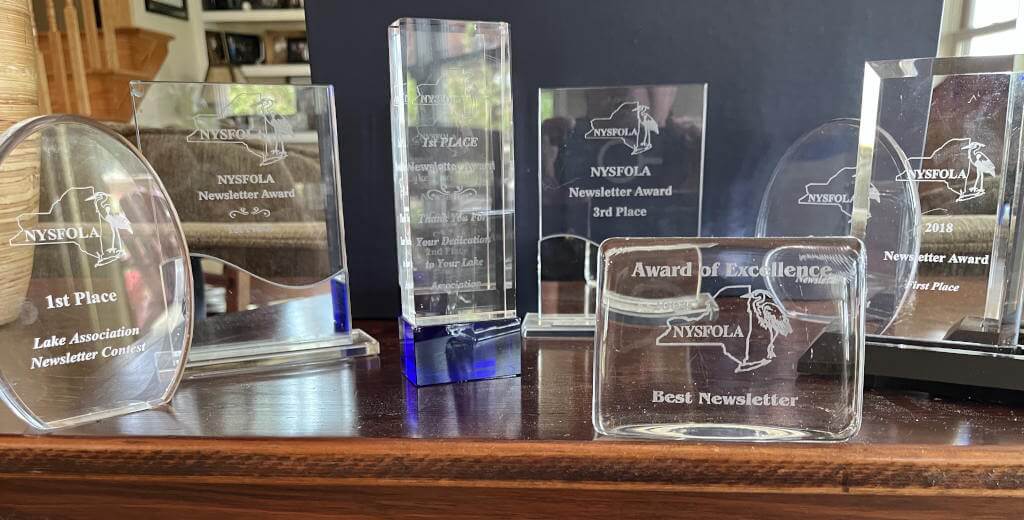
Each year the New York State Federation of Lake Associations (NYSFOLA) has a competition for lake association newsletters. Lakes are assigned into categories small, medium, and large. We are in the medium category, although we compete against lakes as large as Saratoga Lake. Here is how we have done to date:
2004---Best newsletter
2008---1st place
2012---1st place
2013 --- 1st Place
2014---2nd place
2015---3rd place
2016---1st place
2018 --- 1st place
2019 --- 1st place
2023 --- 2nd place
Yes, you do need to be part of the Facebook community (i.e. logged in as a member of Facebook) in order to see our page. Once you are on Facebook, simply type “Copake Lake Conservation Society” into the main search box to find our page. Be sure to “Like” us when you are there, so that our updates show up in your timeline!
Our website is the repository of detailed information, both current and archived, about the Copake Lake Conservation Society. On the website you will find the full calendar of all events for the year, detailed articles on lake management and other important topics, “About Us” information and links to join, volunteer, and sign-up for our email list. The website houses all the core information we have accumulated over the years and want to share with our members.
Facebook and Instagram, on the other hand, are social networks that are used by many organizations, including ours, to post short and timely bits of information, photographs and videos that can easily be shared among users. Facebook and Instagram users come to us expecting to “comment,” "like," and "share" our postings. It is also a perfect venue for sharing photographs of our lake and our community activities. People don’t go to social networks to read lengthy prose, and the things we share there are in a “timeline” format, continually moving down as they are replaced by other brief, current information. We believe that Facebook and Instagram are important tools when we are communicating any ”breaking” information, as well as a place to share images and short links that will take users to read longer newsletter and web articles. As such, they are critical component of building and maintaining a sense of community among our residents, both new and old.
ABOUT THE COPAKE LAKE CONSERVATION SOCIETY
The Copake Lake Conservation Society is a volunteer organization working to protect the quality of the Copake Lake watershed, preserve the ecological balance, and promote safe recreational use of the lake.
The CLCS is a member-supported organization that is managed by a volunteer Board of Trustees. Trustees are elected to hold office for a term of two years, and must meet the following qualifications:
Any member who meets the qualifications may apply to the Board of Trustees for candidacy. The Board meets a minimum of three times annually, and meetings are open to all members. Trustees are elected at our Annual Meeting. We are always looking for interested, qualified CLCS members to join our Board of Trustees as volunteers. If you would like to apply, Click on this link to download an application.
Your completed application can be scanned and emailed to us at info@copakelakecs.org or mailed to:
Copake Lake Conservation Society
PO Box 37
Craryville, New York 12521
The general policies and practices of CLCS are established according to our Bylaws. The bylaws can be downloaded on the Who We Are page from the main menu.
Any questions or concerns can be emailed to us at info@copakelakecs.org.
Inquiries are forwarded to the appropriate officer or committee chair, and will be responded to as quickly as possible.
All CLCS meetings are open to all CLCS members. Members are welcome to attend any of the scheduled meetings and to participate in discussions. Members are highly encouraged to attend our Annual Meeting in July, where current lake related issues are presented and discussed.
Revenues are raised through our membership dues, various fundraising activities (Summer Bash, Labor Day Raffle, and merchandise sales), and donations. Funds are used for expenses related to lake management and treatments, communication expenses such as our newsletter, website, and email marketing, as well as for educational programs and grants.
BECOMING INVOLVED IN CLCS: Individuals & Businesses
Membership in CLCS is open to any contributing individual age 18 or older, or to any business that has made a minimum contribution of $150. Each paid membership entitles the individual or household to one vote at our annual meeting. Membership must be paid for the current year in order to vote at the Annual Meeting in July. You can become a member or renew your current membership, either online or by mail, by visiting the Membership page on our website.
You can sign up to receive our email newsletters through our website by clicking on the “Join Our Mailing List” tab which is on every page in the upper right corner. If you do not already receive our print newsletter, please email us at info@copakelakecs.org and ask to be added to the mailing list.
Volunteers play an integral part in the success of our organization. Please consider volunteering on one of our various committees. Committee membership is open to any CLCS member in good standing. To view a list of committees, visit our Who We Are page.
If you are interested in joining, email us at info@copakelakecs.org. Your inquiry will be forwarded to the appropriate committee chair.
As a business owner, you can support CLCS in the following ways:
We very much appreciate the support of our local enterprise community! Businesses can advertise in both our award-winning newsletter and on our website.